

6 Problems You Didn’t Know Your Site Had
You check your analytics and the numbers look fine. People are finding your site. They’re showing up. And then… nothing.
No calls, no contact forms, no new customers walking through the door.
If that sounds familiar, the problem obviously isn’t traffic. For a lot of business owners across, what’s missing is the connection between a visitor showing up and a visitor taking action. A well-planned internet marketing service doesn’t just send people to your website, it builds a site experience that turns those visits into real conversations.
Key Takeaways
- Traffic without leads means a disconnect in your message, site experience, or visibility strategy.
- Most fixes don't require a full redesign, they're targeted adjustments that remove friction.
- SEO, paid ads, social media, and website content need to work together. A gap in any one area breaks the chain.
- Tracking where visitors drop off matters just as much as tracking how many arrive.
- AI-driven search means more people form opinions about your business before they ever click to your site.
First: Conversations Are the Goal (Not Traffic)
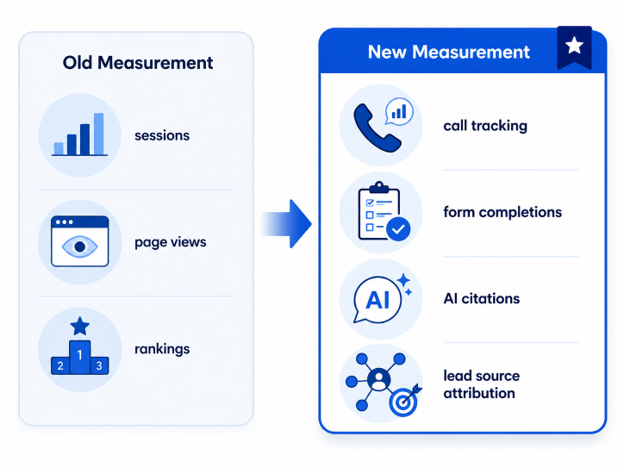
Sessions and page views feel good when they trend up. But sessions don’t pay the bills. Phone calls do. Form submissions do. Signed estimates do.
The gap between “someone visited” and “someone hired me” is where most businesses quietly lose revenue, and it’s usually caused by a handful of fixable issues. Here’s how to find them.
Problem 1: You're Attracting the Wrong Traffic
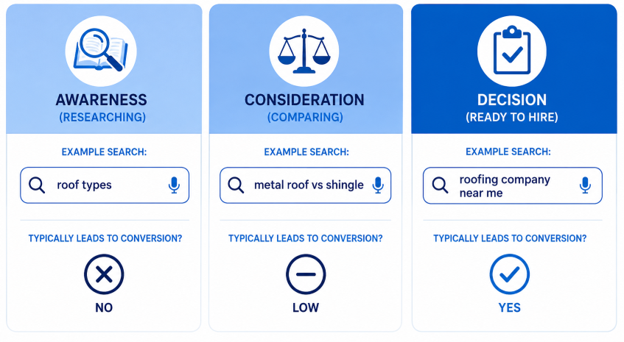
Not all traffic converts. If your SEO targets broad keywords that don’t match what buyers are actually searching for, you’ll get visitors with zero intention of calling.
A roofing company ranking for “roof types” attracts researchers, not customers ready to book. A plumber ranking for “DIY pipe fix” hands out free education to people who’ll never call.
What to check:
Keyword intent
Are your top-ranking terms matched to someone ready to hire?
Geographic specificity
Local service businesses need local traffic. National visitors rarely convert.
Landing page match
Does the page a visitor lands on match what they searched for? Intent mismatch is one of the most common conversion killers.
Pro Tip: In Google Analytics 4, check your highest-traffic pages. Low engagement time and zero form submissions = the traffic and page aren’t aligned.
Problem 2: Your Website Doesn't Clearly Answer the Three Questions Every Visitor Asks
Visitors make a snap judgment in seconds. They’re answering three questions, usually without realizing it:
- Is this for me?
- Can I trust these people?
- What do I do next?
If your homepage can’t answer all three immediately, visitors leave. Not because they don’t need your service, but because you didn’t give them a reason to stay.
What to check:
- Your headline — Does it name the result you deliver? "Northern California's Trusted Roofing Company" works. "Welcome to ABC Roofing" does not.
- Trust signals above the fold — Reviews, years in business, certifications. Credibility proof before the scroll.
- One clear CTA — "Get a Free Estimate" or "Schedule a Call." Multiple competing CTAs create indecision.
Problem 3: Your Contact Path Has Too Much Friction
Even a motivated visitor abandons if reaching out feels like work. Every step between “I want to contact them” and “I actually did” costs you leads.
What to check:
- Form length — Name, email, and a brief project description is enough. Eight required fields loses most people who start.
- Visible phone number — A clickable number in your header captures visitors who won't fill out a form.
- Mobile experience — More than half of local business visits come from phones. A hard-to-tap form costs leads daily.
- Post-submission confirmation — If nothing happens after a form submit, visitors don't know it worked. A simple "We'll be in touch within one business day" builds trust immediately.
Problem 4: Your Content Isn't Written for the Decision Stage
Most business websites are written for awareness, general service descriptions and company history that give visitors no real reason to choose you over the competitor in the next tab.
- Why you instead of the three other companies I found?
- What does working with you actually look like?
- What results have your clients seen?
What to check:
- Case studies or results — Amy's Roofing & Solar went from 20% digitally attributed closed deals to 37% after partnering with WSI Smart Marketing. Specific outcomes move buyers.
- Outcome-based testimonials — "Great company!" does little. "They generated 60–75 calls a month for us" converts.
- Service page depth — Each service deserves its own dedicated page with a clear CTA. One long services overview page leaves organic traffic on the table.
Is Your Digital Strategy Sending Mixed Signals?
Any of this sounding familiar? It’s worth stepping back and looking at the full picture. Your SEO, your paid ads, your social media, and your website content all need to pull in the same direction. When they don’t, traffic still shows up, it just doesn’t convert.
WSI Smart Marketing offers a free consultation to walk through your current performance and identify the highest-priority gaps. Reach out and schedule yours today.
Problem 5: You're Measuring Traffic When You Should Be Measuring Conversion
WSI CEO Ryan Kelly addresses this directly in his AI on the Fly video series:
“We need to displace the weight of measurement away from traffic and move it over to conversion tracking. Tracking your conversions with clearer attribution is now critical, not just the money we’re spending and where we’re spending it, but our efforts, where we’re spending time, and the kind of content we’re writing.”
That shift is urgent now. AI Overviews and answer engines influence decisions before visitors ever click to your site. A customer might call directly from a Google AI answer or your Business Profile, none of which shows up in traffic stats.
What to check:
Call tracking
Tools like CallRail tag every phone lead to its source: organic, paid, social, or direct.
GA4 conversion goals
Set goals for form completions, phone link clicks, and booking submissions. Without them, you can’t tell which pages earn leads and which ones just consume budget.
AI visibility
Is your business appearing in AI Overviews, ChatGPT, or Gemini when someone searches your category locally? These channels drive conversions that never show up as website traffic.
Problem 6: Your Digital Presence Isn't Consistent Across Channels
Your website is one piece of a larger footprint. Before contacting you, potential customers check Google Maps, Facebook, Instagram, and review sites, and if those touchpoints look neglected or contradictory, trust erodes before they ever reach your contact form.
What to check:
Google Business Profile
Current, complete, and actively collecting reviews. For local businesses, the GBP often gets more eyes than the website.
Review recency
A strong rating with recent reviews signals an active business. No new reviews in 18 months raises questions.
Social activity
A dormant profile hurts credibility for visitors doing their due diligence.
NAP consistency
Your Name, Address, and Phone must match across every listing and directory. Inconsistencies confuse both customers and search engines.
What WSI Smart Marketing Can Do for You
WSI Smart Marketing has helped businesses across the western U.S. close the gap:
- Holly Construction — grew to a predictable 60–75 calls per month; best year in company history
- McLea's Tire — up to 400% growth in organic traffic inquiries; revenue to open a second location
- Moore Home Services — 435% organic traffic growth alongside a rebuilt, conversion-focused website
The common thread: right traffic, clear messaging, tracking what actually converts. An internet marketing service that ties SEO, content, paid search, and conversion tracking into one plan is what moves the needle.
Ready to Turn Your Traffic into Leads? Contact WSI Smart Marketing
If your analytics show traffic and your phone isn’t ringing, the problem is diagnosable. Let’s find it together. WSI Smart Marketing offers a free consultation for business owners who want a clear picture of what’s working and what’s costing them leads.
Related posts you might find helpful:
Frequently Asked Questions About Internet Marketing
How much traffic does a website need before conversion becomes the priority?
If your site gets more than a few hundred visits per month and generates few leads, conversion issues are almost certainly a factor. Traffic in the 300–500 monthly sessions range should produce regular inquiries when it’s well-targeted and the site is built to convert.
Can I fix these problems myself or do I need an agency?
Some fixes are DIY-friendly: rewriting a headline, shortening a form, or setting up a GA4 goal. Others — keyword strategy, technical SEO, conversion rate optimization — require tools and time. An internet marketing service audit can tell you which fixes to prioritize and which need ongoing support.
My bounce rate looks high. Is that the problem?
Not necessarily. Focus on goal completions rather than bounce rate alone. High bounce with strong call volume isn’t a problem. High bounce with zero conversions is.
How long does it take to improve lead volume?
Paid search can show results in days to weeks. SEO and content improvements generally take 3–6 months. Conversion rate fixes — streamlining a form, rewriting a CTA — can show impact quickly once enough traffic flows through the updated page.
Does any of this change with AI search?
Yes. AI Overviews and answer engines like ChatGPT and Gemini influence decisions before a customer ever visits your site. Businesses cited as trusted sources in AI answers generate calls and leads that never register as website traffic — making conversion tracking and a consistent digital presence even more critical.


Recent Comments