A customer needs a plumber. Instead of scrolling through Google, they open ChatGPT, ask for a recommendation, and get three names back. Is your business one of them?
That moment explains why AI search optimization matters right now. The way people find local businesses has changed across Google, AI tools, YouTube, and social media, and the companies getting named in AI answers are the ones doing the work to be understood and trusted. This guide ties the whole picture together and shows you what to do about it.
Key Takeaways
- AI search optimization gets you named, not just ranked. It’s the work of making your business clear, structured, and trusted enough that AI tools recommend you, built on the SEO you already need.
- Your customers search in more places than Google now. AI Overviews, ChatGPT and Gemini, YouTube, social media, and Reddit all matter. Showing up in one channel leaves you invisible in the rest.
- Getting found is only half the job. Turning that visibility into calls and customers depends on a clear website, an easy contact path, and tracking conversions instead of only traffic.
What AI Search Optimization Actually Means
AI search optimization (also called AI Optimization or AIO) is the practice of preparing your content and online presence so AI systems can read it, verify it, trust it, and recommend it. The goal is simple. When a customer asks an AI tool for help in your category, your business shows up in the answer.
The Four Parts That Work Together
- Helpful content. Pages written to answer the real questions your customers ask, written for people first.
- Readable structure. Clear headers, short paragraphs, and schema markup (code that labels what your content is, such as your business name, services, and location) so AI can pull your answers cleanly.
- Trust signals. Reviews, named expertise, and mentions on other reputable sites that make you safe to recommend.
- Visibility tracking. Reporting that shows which AI tools mention you, how often, and for which questions.
All of this builds on your existing SEO. AIO sits on top of it. That relationship runs through everything below, so it’s worth holding onto from the start.
How AI Decides Which Businesses to Recommend
When someone types a question into Google today, an AI Overview often answers at the top before any website links appear. Ask ChatGPT, Gemini, or Perplexity the same question, and you get a short written recommendation that names only a few businesses.
Google reported that its AI Mode passed 1 billion monthly users in 2026, and the average AI Mode question runs about 3 times longer than an old keyword search. People are asking full questions and expecting a complete answer.
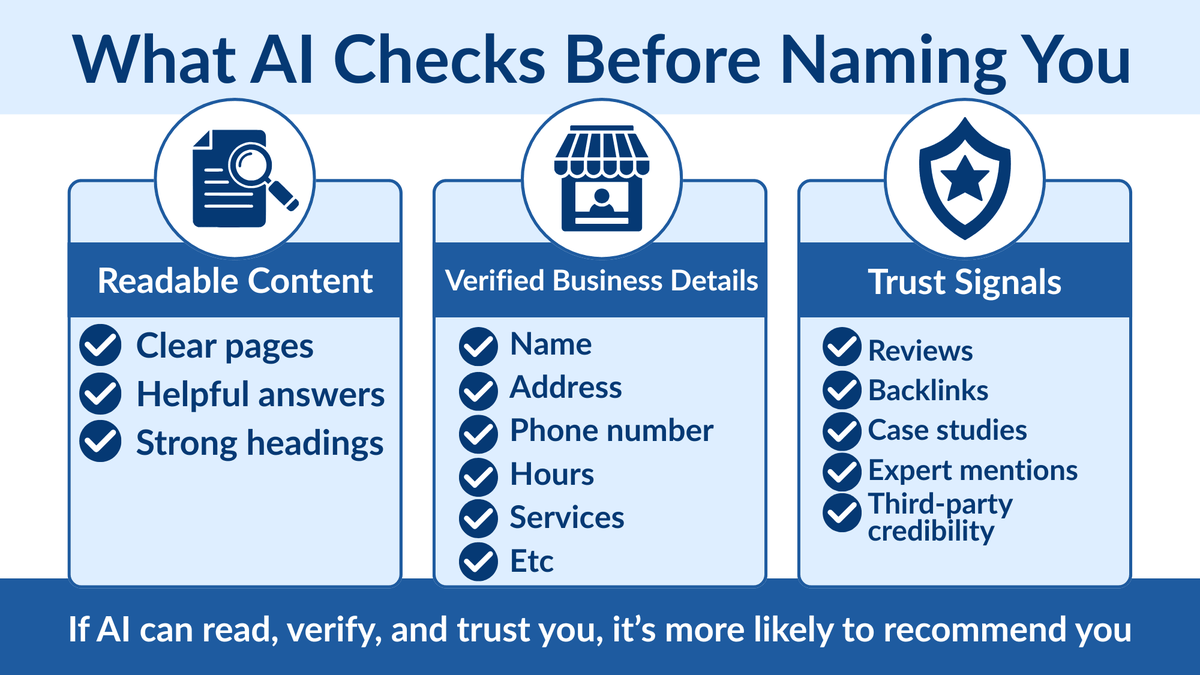
The Three Things AI Checks Before Naming You
- Can it read your content cleanly? Clear, well-organized pages give AI something to quote.
- Can it confirm the facts about your business? Consistent details across the web prove you’re real.
- Can it find outside proof you’re credible? Reviews and mentions on other sites tell it you’re worth recommending.
Fall short on any one of those, and you become harder to recommend. A competitor who made the information easier to use gets named instead.
As Ryan Kelly, founder of WSI Smart Marketing, puts it:
“AI doesn’t just read words. It reads context. It reads authority.”
The words on your page still matter, and so does everything around them that tells an AI you’re the real, credible answer.
Why So Many Businesses Stay Invisible
Most companies that get left out of AI answers share a handful of fixable problems:
The site reads like a brochure
Slogans such as “Quality Service, Trusted Results” give an AI almost nothing to quote. A heading that reads “Emergency Roof Repair for Homeowners in Santa Rosa” tells it exactly who you help and where, which is the kind of detail it can drop straight into an answer.
There’s no structure to read
Without clear headers, short paragraphs, bullet lists, FAQ sections, and schema markup, your best information sits on the page unread.
The trust signals are thin
No reviews, named experts, or proof of past work makes a business look risky to put in an answer.
The business details don’t match
When your name, address, phone, hours, or services differ across your website, Google Business Profile, and directories, AI can’t confirm which version is correct.
Each of those has a direct fix, and together they make up the core of AI search optimization.
SEO is Still the Foundation AI is Built On
A question keeps coming up from business owners: if AI just answers the question anyway, does search engine optimization even matter anymore?
Yes, and the reason is structural. AI answer engines don’t run on guesswork. They pull from the same content base that Google has always indexed. Google’s own Search Central documentation confirms that generative AI features in Search are rooted in Google’s core ranking, crawling, indexing, and quality systems. Technical SEO isn’t optional for AI visibility. It’s required.
What AI Looks for When it Picks Who to Cite
- A technically sound site. Fast, mobile-friendly, and crawlable, so an AI can actually read it.
- Content that answers real questions. Thorough pages written for a person with a specific need, not thin keyword pages.
- Authority signals. Reviews, backlinks, and consistent business information across the web.
- Parseable structure. Headings, FAQ sections, and schema markup that let AI lift a clean answer.
Every item on that list is what SEO has always produced. The difference now is the stakes. A business that ignored SEO in 2018 might have slipped in rankings. A business that ignores it in 2026 may not appear in AI-generated answers at all.
Fewer Clicks, Same Customers
AI Overviews now appear above traditional ranked links on many queries, summarizing an answer or recommending a business before anyone sees a list of websites. This is zero-click search, and it changes how a customer finds you and decides to call.
Ryan Kelly addressed it directly on his AI on the Fly video series:
“You may experience less traffic to your website, but if you’re being cited as the authoritative source to answer that question, you’re still going to get that conversion. You may still get that phone call, that new client, that new patient.”
— Ryan Kelly, AI on the Fly, Episode 10
Fewer clicks doesn’t have to mean fewer customers. If your business is the source AI cites, you still win the call.
Where Your Customers are Actually Searching
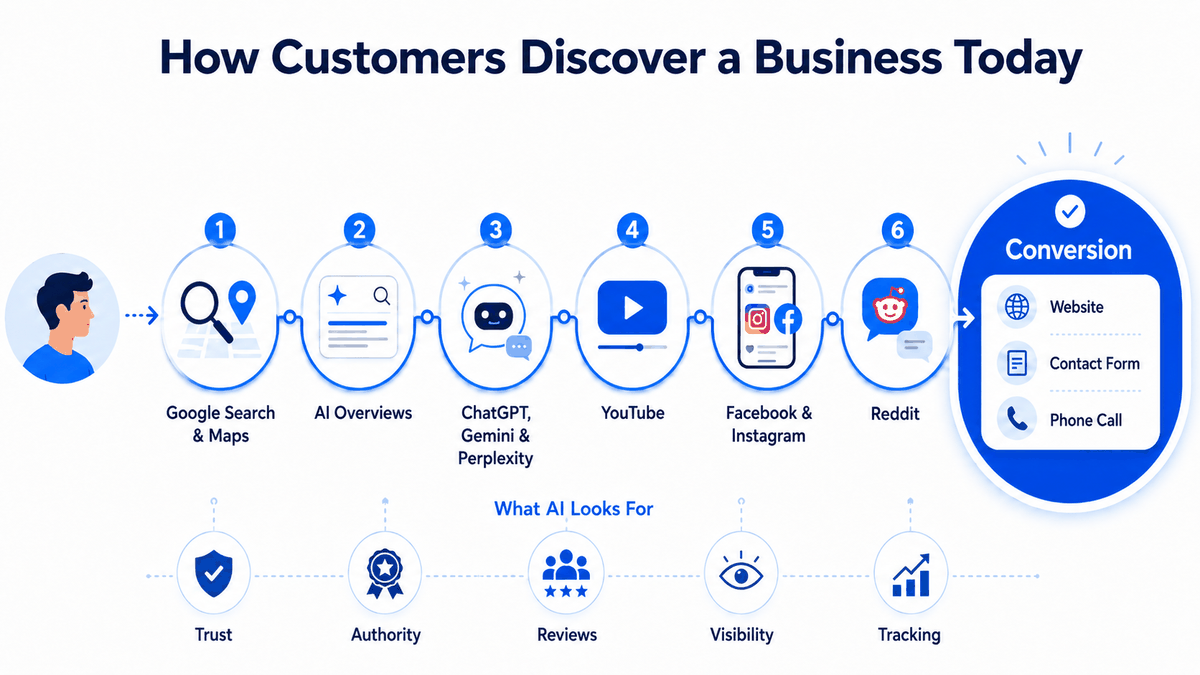
Think about the last time you hired someone: a contractor, a dentist, a new accountant. You probably didn’t type two words into Google and call the first result. Your customers don’t either. They move across several platforms before they ever reach out.
Ryan Kelly put the shift bluntly on AI on the Fly: “Search engine optimization is dead. Search everywhere optimization is raging and alive.” That’s a strong way to say search has spread out. Here’s where it spread to.
Google and AI Overviews
Still the starting point for most searches, and still the base of any strategy. Strong organic rankings and AI Overview citations both come from well-structured content that answers real questions. Your Google Business Profile feeds local AI answers directly, so keep hours, categories, and services accurate.
ChatGPT, Gemini, and Perplexity
A growing first stop for research and comparison shopping. Ask one of these for the best roofing company in Sonoma County and you get a direct recommendation, often without a single website visit. If your content isn’t structured to be cited, you’re invisible here.
YouTube
The second-largest search engine in the world, and one of the highest-intent platforms for service businesses.
- A homeowner searching “how to know if I need a new roof” is early in a buying decision, and a clear, well-lit video builds trust faster than any written ad.
- YouTube videos also show up in Google results, so one video earns double exposure.
Facebook and Instagram
Where local customers confirm you’re real, active, and worth contacting. Regular photos of completed work and recent engagement build credibility. AI tools increasingly index social content too, so consistent posts double as trust signals.
This one surprises most owners. Reddit threads regularly land on page one of Google for research-style searches and get cited by AI tools as community sources. You can’t control what people post, but strong reviews and a consistent presence give them something worth saying.
A strong Google ranking doesn’t automatically mean AI visibility. These tools index content differently. You can rank on page one of Google and still be absent from a ChatGPT recommendation, which is the gap AI search optimization closes.
From SEO to Search Everywhere Optimization
If customers search in all those places, optimizing for one channel only covers one stop on their path. That’s the difference between SEO on its own and Search Everywhere Optimization (SEvO), WSI Smart Marketing’s integrated strategy for the modern search landscape.
“Search everywhere optimization is about getting found or cited as the authoritative source on answer engines or artificial intelligence… it still includes search engines, but now also asks: how do you get cited in Google AI Overviews? How do you get mentioned on ChatGPT, Claude, Perplexity, and other third-party answer engines?”
— Ryan Kelly, AI on the Fly, Episode 11
The Five Services SEvO Coordinates
- SEO. The base of every strategy, always included: technical optimization, content, local SEO, Google Business Profile, and link building.
- AIO (AI Optimization). Getting cited by ChatGPT, Gemini, Perplexity, and Google AI Overviews through structured content, schema markup, and digital authority.
- Paid Search. Google Ads and Microsoft Ads for immediate visibility while organic presence builds.
- Social Media Management. Consistent presence on Facebook, Instagram, LinkedIn, and YouTube that keeps you visible between search moments.
- Digital Public Relations. Earned media and high-authority backlinks that build the trust signals both search engines and AI tools use to decide who gets recommended.
Every SEvO strategy includes SEO and AIO as the required base, then expands based on your goals, market, and where your customers search.
Should You Start with SEO or Go Broader?
Start with SEO if:
- You’re new to digital marketing and need a strong base first.
- Your budget is limited and you want the highest-return single channel.
- Your customers mostly find you through Google Search and Google Maps.
- You’re in a less competitive local market where ranking well is achievable on its own.
Go broader with SEvO if:
- You’re in a competitive market where several businesses chase the same customers.
- Your customers research on YouTube, ask AI tools, or discover you on social media.
- You want faster early leads alongside long-term organic growth.
- You’ve done SEO for a while and hit a ceiling on results.
Not every business needs every platform on day one. Start where your customers already are, then add channels as you grow.
See Where Your Business Stands in AI Search
If you’re reading this and wondering whether AI tools can even find you, that’s the right question to ask. WSI Smart Marketing offers a free consultation and a no-cost look at how AI sees your brand today. We’ll map where you show up across Google, AI tools, social platforms, and beyond, and where the gaps are.
Call us at (707) 843-3714 or take a look at our AIO and Search Everywhere Optimization services.
Getting Found is Only Half the Battle
Showing up in AI answers brings the right people to your door. Whether they walk through it is a separate problem, and it’s where a lot of businesses quietly lose revenue.
You’ve probably seen it: analytics look fine, people are finding the site, and then nothing. No calls, no contact forms, no new customers. Sessions and page views feel good when they trend up, but sessions don’t pay the bills. Phone calls do. Form submissions do. Signed estimates do.
The three questions every visitor asks
Visitors make a snap judgment in seconds, usually answering three questions without realizing it:
- Is this for me?
- Can I trust these people?
- What do I do next?
If your homepage can’t answer all three right away, people leave.
Make the answers obvious
- Lead with the result you deliver. “Northern California’s Trusted Roofing Company” names it. “Welcome to ABC Roofing” doesn’t.
- Put proof above the fold. Reviews, years in business, and certifications give credibility before the scroll.
- Use one clear call to action. “Get a Free Estimate” beats three competing buttons that create indecision.
Remove friction from the contact path
Even a motivated visitor abandons if reaching out feels like work.
- Keep forms short. Name, email, and a brief project description is enough. Eight required fields loses most people.
- Show a clickable phone number in the header for visitors who won’t fill out a form.
- Make it work on mobile, since more than half of local business visits come from phones.
- Confirm the submission. A simple “We’ll be in touch within one business day” builds trust right away.
Measure conversions, not just traffic
AI search means some of your best customers chose you without ever landing on your site. They read the AI answer, saw your business cited, and called you directly. Ryan Kelly made the case on AI on the Fly for moving the weight of measurement off traffic and onto conversion tracking with clear attribution.
Track these alongside your rankings:
- Direct calls and contact form submissions
- Branded search volume (are more people searching for you by name?)
- Presence in AI Overviews and third-party answer engines
- The quality and source of incoming leads, not just the volume
Website traffic is a useful signal. It isn’t the only one.
How WSI Smart Marketing Puts it Together
At WSI Smart Marketing, AI search optimization follows a clear five-step process, and every step aligns with Google’s E-E-A-T standard: Experience, Expertise, Authoritativeness, and Trustworthiness.
- Discover and audit how AI currently sees your brand.
- Adjust your content to meet AI standards.
- Build helpful content and FAQs that answer real questions.
- Monitor where you show up across AI tools.
- Refine as the platforms change.
Results we’ve seen across the western U.S.
- Holly Construction grew to a predictable 60 to 75 calls a month, saw a 77% increase in tracked phone calls, and called it the best year in company history.
- Amy’s Roofing & Solar in Petaluma saw a 570% increase in tracked calls and grew digital-attributed closed deals from 20% to 37% of total business.
- Toxic Angelz Bikinis earned 73 AI-generated citations across ChatGPT, AI Overview, AI Mode, and Gemini, alongside a 13x return on their first paid search campaigns.
Each one started with solid SEO and grew when the strategy expanded to the platforms where their customers were deciding. See more in our case studies.
We’re based in Santa Rosa and rooted in Sonoma County, with the research and playbooks of a global network behind every plan. That mix is how a local roofer and a national swimwear brand can both get named where their customers are searching.
What to do next
- Test how AI sees you. Ask ChatGPT, Gemini, and Google’s AI Mode for the best business in your category and area. Note whether you appear, and who does.
- Read your top pages like a customer. If they’re full of slogans but light on information, rewrite them to answer real questions clearly.
- Add structure. Use clear headers, short paragraphs, and an FAQ section on key pages, with schema markup where possible.
- Strengthen trust. Collect reviews, add author bios and case studies, and keep your business details identical across every platform.
- Track conversions. Set up call tracking and conversion goals so you can see real results, not just session counts.
Related posts you might find helpful:
- Where Are Customers Actually Searching for a Business Like Mine?
- My Website Gets Traffic but No Leads! What’s Going Wrong?
- Is SEO Still Worth It If AI Answers Questions?
- Why Isn’t My Business Showing Up in ChatGPT or AI Overviews?
- SEO or Search Everywhere Optimization: Which Does Your Business Actually Need?
Ready to Get Found in AI Search? Talk to WSI Smart Marketing
Missing from AI answers is a fixable problem, and it’s the exact work our AIO and SEvO services handle. At WSI Smart Marketing, we audit how AI tools see your brand today, find the gaps, and build a plan to get you cited where your customers are already searching.
Have a business in California, Arizona, Nevada, Oregon, or Washington State? Reach out for a free consultation.
Frequently Asked Questions
What is AI search optimization?
AI search optimization, or AIO, is the practice of preparing your content and online presence so AI tools can read, verify, trust, and recommend your business. The goal is to have your company show up when a customer asks an AI tool for help in your category. It covers content, structure and schema markup, trust signals, and visibility tracking, all built on top of solid SEO.
Is AI search optimization different from SEO?
Yes, though the two work together. SEO focuses on ranking your pages in search engines like Google. AI search optimization prepares your content to be understood, trusted, and recommended by AI tools such as ChatGPT, Gemini, and AI Overviews. AIO is built on top of strong SEO, not in place of it.
Do I still need SEO if AI answers the question?
You do. Google’s AI features, including AI Overviews and AI Mode, are built on the same indexing and ranking systems that traditional SEO influences. Businesses with strong SEO are better positioned to be cited in AI-generated answers, and a clean, fast, well-structured site is a requirement for AI visibility.
Where are my customers actually searching?
In more places than Google alone. Customers research across Google and AI Overviews, AI answer engines like ChatGPT and Gemini, YouTube, Facebook and Instagram, and Reddit before they contact a business. You don’t need to be everywhere on day one. Start with the platforms your customers use most, then expand.
How long does AI search optimization take?
It depends on your starting point, your industry, and how competitive your market is. Content and structure changes can be read by AI fairly quickly, while trust and authority signals usually build over several months. AIO is ongoing work because the AI platforms keep changing how they choose answers.
Can a small local business actually get recommended by AI?
Yes. When your content is clear, well-structured, and backed by real reviews and consistent information, AI tools can cite a small business as readily as a large one. Strong local signals and genuine expertise often matter more than company size.


Recent Comments